Documentation
Learn how Polypane improves your workflow
Pitching Polypane
Getting buy-in for a new dev tool like Polypane usually means getting your team or employer on board, and they might have practical questions about how Polypane fits in with your existing workflow and what the benefits are. This page has some of the common questions people get when they evaluate Polypane. If you have a question that's not covered here, reach out and we'll help directly.
If you want a template specifically to ask your manager or team lead for a license, check out our Manager pitch template.
Common objections
"Our current browser setup works fine"
Every modern browser is excellent at rendering pages, but they're not designed to help you catch issues during development. So "fine" is good for browsing the web, but not for building it. The gap between "fine for browsing" and "fine for development" is why Polypane exists. A regular browser will try to make a page work for their user. In a regular browser mobile checks, accessibility audits, and meta tag reviews all take effort to do manually so they often get skipped.
A problem caught while the code is still open takes a minute to fix snce you're already in the part of the code that needs changing. When the same problems is only caught in QA or even after deployment, it takes more time from more people because someone needs to report it, someone needs to find a reproduction to validate it, create a ticket clearly describing the issue and then a developer needs to context switch back to the project, find and read the code they thought was finished, and then fix the issue. Polypane surfaces these issues during development, so they're fixed before they become bugs.
Polypane puts all of these checks in one place, always on. Multiple viewports are visible at the same time, the accessibility panel surfaces issues as you work, and meta information is one click away. Teams using Polypane typically see up to an order of magnitude less post-deployment patch-up work.
"It would be too disruptive to switch right now"
Polypane runs alongside your existing browser without replacing it for everyday use. Install the browser helper extension to send any tab to Polypane with one click, or configure your dev server to open localhost URLs in Polypane automatically.
There's no migration. If the multi-pane layout feels like too much at first, start with a single-pane view using the Chromium devtools you already know. When the team is ready, one person configures a shared project with the right viewports and environments so everyone loads the same setup with one click.
Switching tools is a one-time adjustment. A QA cycle catching something that should have been caught earlier is a recurring cost.
"We can do all this with extensions"
You can approximate most of what Polypane does by combining devtools resizing, responsive mode, Lighthouse, an accessibility extension, a contrast checker, a meta tag inspector, a screenshot annotation tool, a screen recorder, a JSON viewer, a device lab, a broken links monitoring system, a web vitals monitoring system, and more. Some of those tools exist as extensions, and you probably don't use them anyway.
Even if you use these tools, they don't work together. Checks happen one at a time, in a single viewport, in tools that don't share context. A layout that looks fine at 1280px might break at 375px, but you won't see both at once. Because each check takes effort to run, they happen at the end of a task rather than during it.
Fixing issues at the end of a task is more time-consuming than fixing things you're already working on and when you're short on time, that's the first thing that gets skipped.
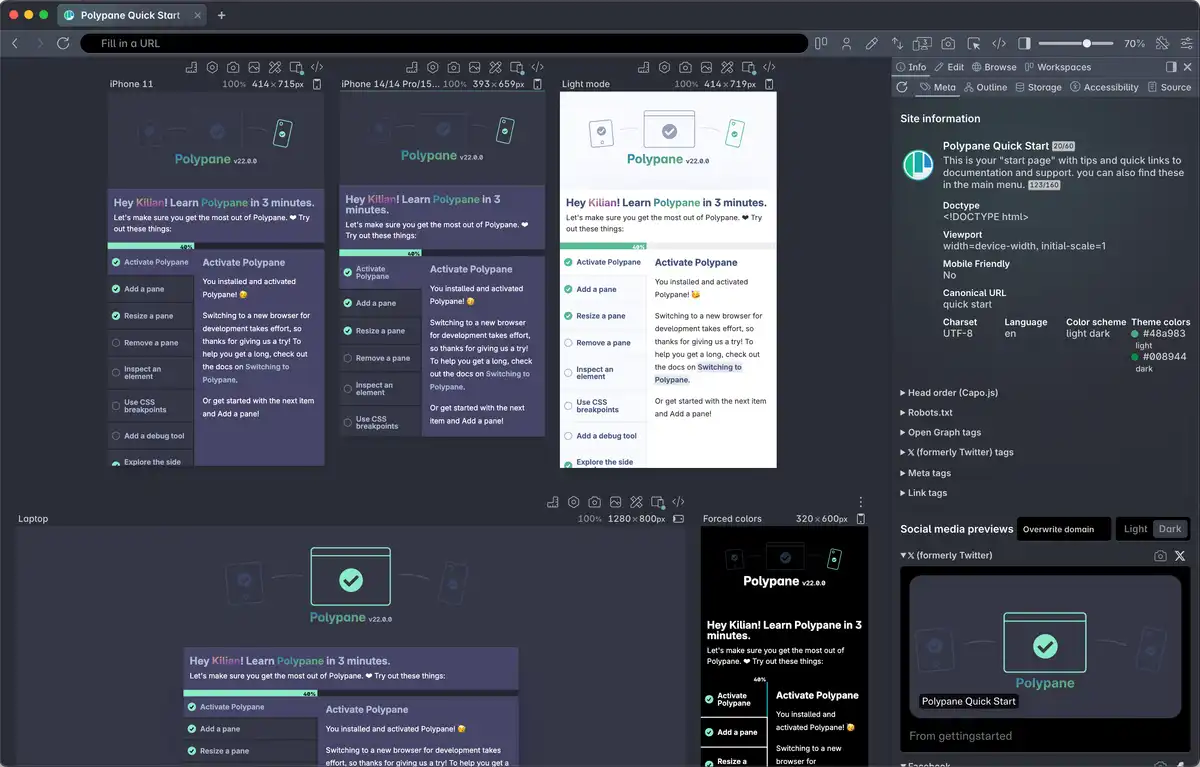
Polypane shows everything side by side while you work, so problems that only appear at certain sizes or under specific conditions are clearly visible even when you're not actively looking for them.
"Our site doesn't need to be responsive"
Responsiveness is the most visible reason to use Polypane, but not the only one. A fixed-layout site still needs to work at different text sizes, in dark mode, with high contrast settings or with images disabled, and for users who rely on assistive technology.
All of those conditions are easy to skip in normal browsers for the same reason mobile checks are. The checks provided by our emulation options, accessibility panel, debug tools and meta information panel apply to any site, since they have a direct impact on the user experience regardless of layout.
"We have a QA team for this"
The goal isn't QA finding issues, it's QA not finding issues that could've been prevented. When QA is where most problems surface, every fix requires a ticket and that means a developer has to switch contexts to go back to work they throught was finished. That context switch is expensive, and it happens more often when checks are inconvenient during development.
A developer who spots a layout issue while writing CSS fixes it in seconds. The same issue found by QA takes a full cycle to triage, reproduce, and fix. Found after deployment, it's an incident: unplanned work, a rushed fix, and a re-deploy.
QA time spent catching things that should have been caught earlier is expensive and wasteful. Polypane doesn't replace QA. Developers using Polypane means QA can focus on things that genuinely need human judgement.
"Our design system handles responsiveness"
A design system provides the building blocks, and a tool like Storybook helps review them in isolation. Neither can guarantee the blocks are assembled correctly in context with real content at real sizes. Components get combined in ways the design system didn't anticipate, long strings overflow, and a nav that works with five items breaks with eight. That's an integration problem that only shows up on real pages with real content.
Polypane surfaces these during development, at the sizes and conditions where they actually occur.
"We already use BrowserStack or Sauce Labs"
These tools test finished work across real browsers and devices. Polypane is used during development, while you're still building and iterating.
Online device labs tell you whether your finished work renders correctly in Safari on iOS. Polypane surfaces layout issues, contrast failures, and structural problems while you're building them. Finding those things in BrowserStack means revisiting work that's already done.
"Polypane uses Chromium, so it won't catch real browser differences"
That's true, and we say so on the homepage. Polypane is built on Chromium and won't surface bugs that only appear in Firefox or Safari. You always need to test in multiple rendering engines.
Portal helps here: it shares your local dev server via a URL you can open in any browser or device and control them from inside Polypane, so you can spot-check other engines without switching your primary workflow. Portal is free to use for all Polypane users.
Most issues that make it to deployment aren't engine-specific bugs. They're things nobody checked during development because checking was inconvenient. That's what Polypane catches.
"It costs too much"
At most team hourly rates, the licence pays for itself with 15 minutes saved per developer per month. That's less time than it takes a QA team to reproduce and file a single bug (a bug that Polypane would probably have caught during development). Use the ROI calculator to work out the number for your team's hourly rate.
A post-deployment bug requires someone to report it, a developer to context-switch back to finished work, and a fix to be reviewed and deployed. That sequence can cost more than an annual licence, and it only needs to happen once or twice a year to make Polypane worth it.
If cost approval is the blocker, the sales and procurement page has the information your finance team will need.
"IT or security won't approve another browser"
Polypane is in use at some of the largest organisations in the world. The logos on our homepage give a sense of the companies that have already approved Polypane for their teams. If it cleared their security review, it's likely to clear yours.
When it comes to IT and security, we try to be as transparent as possible about how Polypane works and what data it collects. The IT and security page has everything your IT team needs to assess and approve Polypane. Likewise, the sales and procurement page has all our company information and answers to common vendor onboarding questions. For enterprise customers, a SIG lite assessment and vendor onboarding are available.
If there are specific questions not covered there, reach out and we'll help directly.
Next steps
The easiest way to make the case is to show results. Start a free trial with a few colleagues, follow the quick start, and open a project you're already working on. Frequently, people already find a couple of issues in the first hour of using Polypane that they hadn't seen before, and that makes the value clear to everyone involved.
Switching to Polypane has tips for making the transition smooth.
Have a question about Polypane?
Reach out via (real human) chat, Slack or our contact form:
Contact SupportBuild the way you already build, without missing anything.
Free 14 day trial, no credit card needed.
- 1 Create your account. Takes a minute.
- 2 Download the app. For Windows, Mac & Linux.
- 3 Build your next project with Polypane